
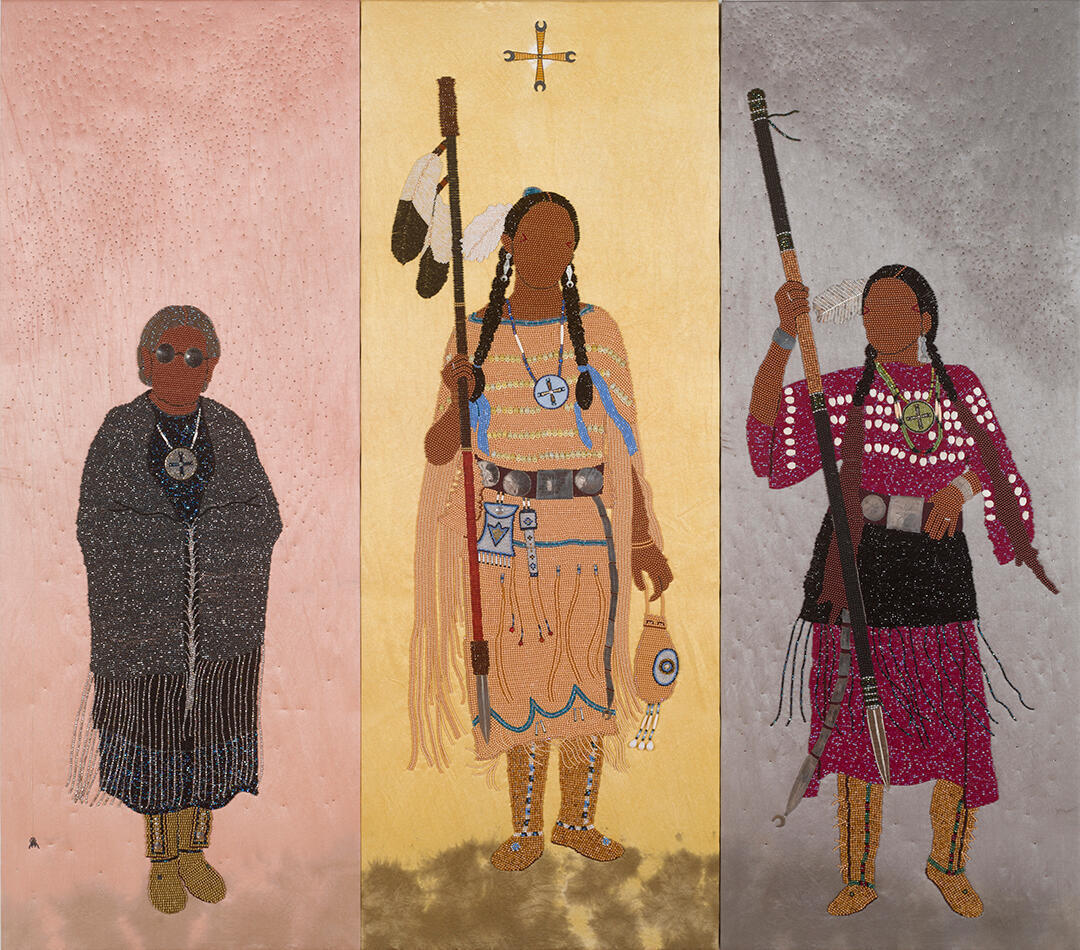
Gkou Stah Gyah, Gyah Sta'ah Gyah
This is my largest artwork to date, completed in 2025. Each section panel of the triptych depicts a Kiowa woman who represents the past, the present, and the future of Kiowa sovereignty, specifically, and Indigenous resilience more broadly. Watch a mini documentary about the work here.
The panel on the left portrays an iconic Kiowa historical figure, Atah (1853 - 1947), known for her prolific beadwork, which featured elongated geometric patterns inspired by the natural world. Atah was the last woman to ride on horseback on a Kiowa war party. She was instrumental in warning the Kiowa people of an imminent attack, saving many lives in the Battle of Palo Duro Canyon. The Grandmother is a figure that emerges within Kiowa oral histories and across many Native American stories, representing common sense and a sacred, special role often connected to wisdom. In the Kiowa community, Grandmothers are responsible for the passage of intergenerational information. Observe the delicately beaded sparkling spider hanging from a star on this panel. This small spider connects to womanhood, motherhood, and matriarchal roles.
The central figure is Atah’s descendant, a young woman named [Bâibàu:dàmà (whose English name is Evelyn Cocker, born 2013). In 2024, [Bâibàu:dàmà was given the honored position of auday mautahn (favored daughter) for Thon Khon Gah (the Kiowa Black Leggings Warrior Society), which bears significant cultural and societal context for current and future generations. Greeves’ depiction of Auday Mautahn [Bâibàu:dàmà symbolizes hope in a bright future and prayer for the continuity of Kiowa sovereignty and of Indigenous nations more broadly. The Child is a figure that emerges within Kiowa oral histories and across many Native American stories, representing innocence or a stage of learning and mistakes. The Child is often the main character of stories whose journey is tied to destiny.
The panel on the right depicts Gyah Khoam Audah, Atah’s namesake (whose English name is Deborah Toyebo, born 1967). Toyebo is a beadworker and the former Women’s Auxiliary President of Thon Khon Gah (the Kiowa Black Leggings Warrior Society). The Mother is a figure that emerges within Kiowa oral histories and across many Native American stories. As a life giver, she is known for her loving care, protection, and at times, great sacrifice. Her presence or absence in stories shapes the character and the protagonists’ journey.
Materials: Beads made of glass, gems, lava rock, mother-of-pearl, and metals, bone hairpipes, crystal montees, pearls, cowrie shells, mescal beans, tin cones, hand-cut and stamped nickel silver, sterling silver, hand-cut bone, 10-carat yellow diamond, 22-karat gold, and metallic thread on hand-dyed hemp silk
Dimensions: 96 x 108 x 2 1/4 in. (243.8 x 274.3 x 5.7 cm)
Collection of the Crystal Bridges Museum of American Art